FSI in Pune: Basic, Premium and TDR by Road Width (UDCPR 2020)
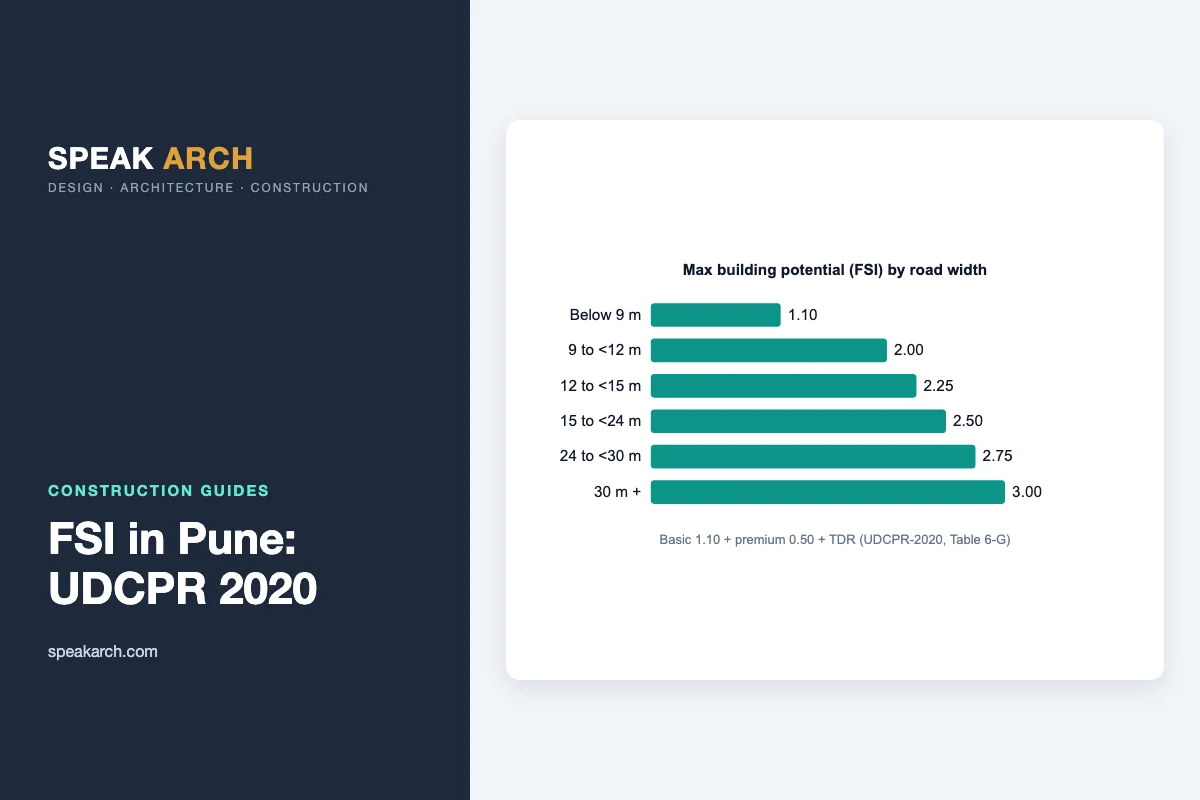
FSI in Pune (UDCPR 2020): for residential buildings in non-congested areas, the basic FSI is 1.10. On roads 9 m wide or more you can add 0.50 premium FSI and TDR, up to a maximum building potential of 2.00 to 3.00 depending on road width. On roads narrower than 9 m, the limit stays at 1.10. Congested areas use a separate table with a basic FSI of 1.50 to 2.00.
Floor Space Index (FSI), also called floor area ratio (FAR), is the total built-up area allowed on a plot divided by the plot area. In Pune the rules are set by Maharashtra’s Unified Development Control and Promotion Regulations (UDCPR) 2020. This guide explains the tables as they appear in the regulation text, with a worked example. It is an educational summary, not a sanction.
Last updated: 29 October 2026. Source: UDCPR-2020 as updated up to 30 January 2023 (copy hosted by Pune Municipal Corporation). Later amendments are not covered; check the current text.
How FSI works in the UDCPR
- Basic FSI: the FSI allowed without paying premium or loading TDR (Regulation 1.3, definition 17).
- Premium FSI: extra FSI bought from the planning authority on payment, subject to road width.
- TDR (Transferable Development Rights): development rights bought from other landowners and loaded onto your plot, up to a maximum.
- Ancillary area FSI: additional FSI of up to 60% of the proposed FSI for residential buildings, on payment of premium (note under Table 6-G).
FSI for non-congested areas: Table 6-G (Regulation 6.3)
The columns below are those the regulation lists for municipal corporations (which include Pune). Other authorities use different premium and TDR limits.
| Road width | Basic FSI | Premium FSI | Max TDR loading | Max building potential |
|---|---|---|---|---|
| Below 9 m | 1.10 | – | – | 1.10 |
| 9 m to below 12 m | 1.10 | 0.50 | 0.40 | 2.00 |
| 12 m to below 15 m | 1.10 | 0.50 | 0.65 | 2.25 |
| 15 m to below 24 m | 1.10 | 0.50 | 0.90 | 2.50 |
| 24 m to below 30 m | 1.10 | 0.50 | 1.15 | 2.75 |
| 30 m and above | 1.10 | 0.50 | 1.40 | 3.00 |
Maximum building potential = basic FSI + premium FSI + TDR. The regulation also says the road-width entitlement may use the width of a highway or major road in some cases where the plot touches a service road. Read note (iv) of the table for the detail.
FSI for congested areas: Table 6A (Regulation 6.1.1)
For congested areas in development plans and gaothans, the regulation gives a different table. If the original land holding is more than 0.40 hectare, the rules for non-congested areas apply except for FSI, which follows Regulation 6.1.1.
| Road width | Basic FSI | Premium FSI | Max TDR loading | Max building potential |
|---|---|---|---|---|
| Below 9 m | 1.50 | – | – | 1.50 |
| 9 m to below 18 m | 2.00 | 0.30 | 0.30 | 2.60 |
| 18 m to below 30 m | 2.00 | 0.30 | 0.50 | 2.80 |
| 30 m and above | 2.00 | 0.30 | 0.70 | 3.00 |
Worked example: a 2,000 sq ft plot, non-congested area
- Road below 9 m: 2,000 × 1.10 = 2,200 sq ft of built-up area at most.
- Road 9 m to below 12 m, basic only: 2,000 × 1.10 = 2,200 sq ft.
- Same road, with premium: 2,000 × (1.10 + 0.50) = 3,200 sq ft.
- Same road, premium and full TDR: 2,000 × 2.00 = 4,000 sq ft (the table maximum).
These are ceilings. What you can actually build is also limited by setbacks, height, parking, ground coverage and fire norms. Premium and TDR cost money, so budget them separately from construction cost. For construction cost, see construction cost per sq ft in Pune.
Things to check before you rely on these numbers
- Which authority and which area: the UDCPR has separate provisions for different authorities and zones, and special rules apply in some areas (for example Koregaon Park height and setback rules in Regulation 10.1).
- Congested or non-congested: this decides which table applies. Confirm it from the development plan or your planning authority.
- Amendments: the text used here is updated up to 30 January 2023. Check the current UDCPR and any notifications.
- Premium rates and TDR availability: not covered here; ask the authority.
- Special schemes: redevelopment, transit-oriented development and similar schemes follow their own regulations.
To calculate permissible built-up area for your own plot, try the FAR calculator and enter the FSI your sanction or architect confirms.
FAQ
What is the basic FSI in Pune?
1.10 for residential buildings in non-congested areas, and 1.50 to 2.00 in congested areas depending on road width, under UDCPR-2020.
Can I get more than 1.10 FSI in Pune?
Yes, if the plot is on a road 9 m wide or more, by paying premium FSI and loading TDR, up to the maximum building potential in the table. On roads below 9 m the table does not allow premium or TDR.
Is FSI the same as FAR?
Yes. In Indian building regulations the two terms mean the same thing.
Does FSI include balconies and staircases?
Some areas are counted and some are exempt, and the rules for this are detailed. Ask your architect to show the FSI calculation from the regulation.
Sources: Unified Development Control and Promotion Regulations for Maharashtra State (UDCPR-2020), updated up to 30 January 2023 (Regulation 1.3, Regulation 6.1.1 with Table 6A, Regulation 6.3 with Table 6-G, Regulation 10.1).
Related: FAR calculator · Construction cost in Pune · Carpet vs built-up area · All construction guides
Disclaimer: Educational only. FSI rules change and depend on your plot, zone and authority. Confirm the permissible FSI with the planning authority or a licensed architect before buying land or filing plans. Disclaimer

Tanmay Arora, is an Architect with an experience of 13+ years. He is a Management Grad with a post Graduate Diploma in Building Construction and Materials. Tanmay has worked with renowned firms. He has graduated in Bachelor of Architecture. His deep interest in Architecture and Civil Engineering and his experience has made him one of the best architects a client can think of.