Standard Footing Size for a 2-Storey House in India (Rule-of-Thumb)
There is no single standard size of footing for a 2-storey house — size depends on column load, soil bearing capacity (SBC), and whether you use isolated, combined, or raft foundations. This page gives indicative starting points for budgeting before structural design.
Typical isolated footing ranges (indicative)
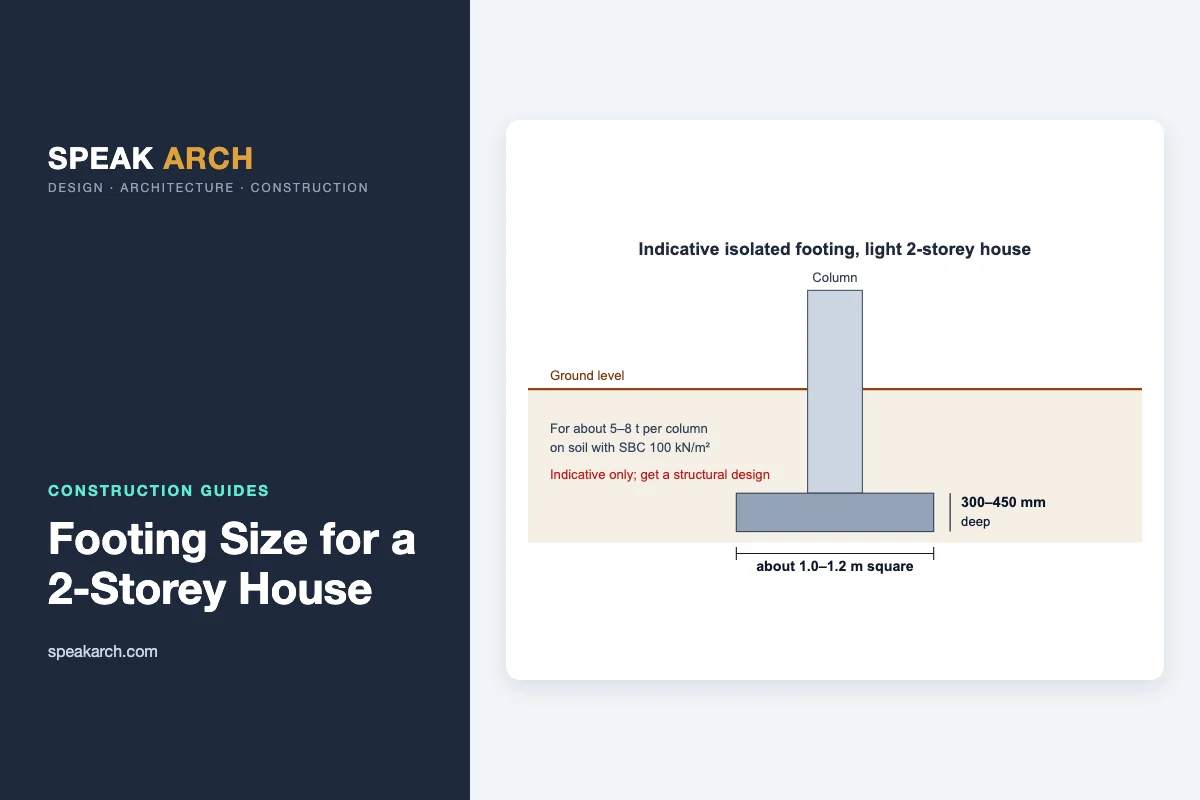
- Light 2-storey load (~5–8 t/col), SBC 100 kN/m²: roughly 1.0–1.2 m square × 300–450 mm deep
- Heavier spans or poor soil: upsize or switch to combined footing / raft
Detailed types: isolated footing guide.
How the footing area is worked out
The footing base must spread the column load so the pressure on the soil stays below the safe bearing capacity:
Footing area = (column load + about 10% for the footing’s own weight) ÷ safe bearing capacity
For a square footing, the side is the square root of that area.
Worked examples (rounded, indicative)
| Column load | SBC 100 kN/m² | SBC 150 kN/m² |
|---|---|---|
| 50 kN (about 5 t) | 0.55 m² → about 0.75 m square | 0.37 m² → about 0.6 m square |
| 80 kN (about 8 t) | 0.88 m² → about 0.95 m square | 0.59 m² → about 0.8 m square |
| 120 kN (about 12 t) | 1.32 m² → about 1.15 m square | 0.88 m² → about 0.95 m square |
In practice, builders round up and keep a practical minimum of around 0.9–1.0 m square even where the calculation gives less, because very small footings are hard to build and leave no allowance for soil variation. Actual column loads on a G+1 house depend on spans, slab type, wall loads and number of storeys, so the table is a way to see how load and soil change the size, not a design value.
Depth, thickness and cover
- Thickness of the footing slab: commonly 300–450 mm for small houses; the structural design decides it, based on shear and bending.
- Founding depth: the base should sit on firm soil below loose fill, topsoil and the zone affected by seasonal moisture change. Typical depths are around 1.0–1.5 m or more, depending on the soil report.
- Concrete cover: IS 456 specifies a minimum of 50 mm cover for footings cast against earth, usually over a levelling course of PCC.
- Reinforcement: mesh bars in both directions, sized by the engineer. Do not copy a bar size from another house.
When isolated footings stop being suitable
- Soil with low bearing capacity, where isolated footings would grow so large that they nearly touch each other.
- Columns spaced closely, where neighbouring footings overlap; a combined footing is used instead.
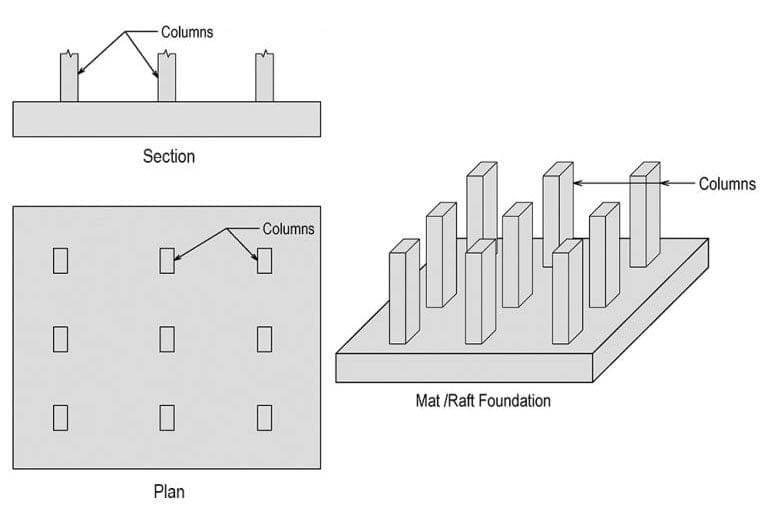
- Soft or variable soil, expansive clay, or a high water table, where a raft foundation may be safer.
What to get before fixing footing sizes
- A soil investigation report (SBC at the proposed founding depth).
- Structural drawings with column loads for your layout.
- Confirmation of future floors. If you may add a floor later, the foundation should be designed for it from the start.
FAQ
What is the minimum footing size for a G+1 house?
There is no universal minimum. Many small houses use footings of around 1.0 m × 1.0 m or larger, but the soil and column load decide it.
Is a 4 ft × 4 ft footing enough for a 2-storey house?
It may be, on good soil and light loads. On soft soil or with large spans it will not be. Check against the soil report and the structural engineer’s design.
Do I need a soil test for a 2-storey house?
Yes. A soil test is the basis for choosing footing type and size, and it costs little compared with the foundation.
Disclaimer: Indicative only — not structural design. Disclaimer

Tanmay Arora, is an Architect with an experience of 13+ years. He is a Management Grad with a post Graduate Diploma in Building Construction and Materials. Tanmay has worked with renowned firms. He has graduated in Bachelor of Architecture. His deep interest in Architecture and Civil Engineering and his experience has made him one of the best architects a client can think of.